Over Op maat gesneden Vinyl Stickers
Aangeboden door
Over dit ontwerp
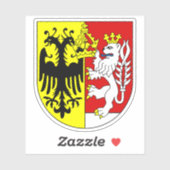
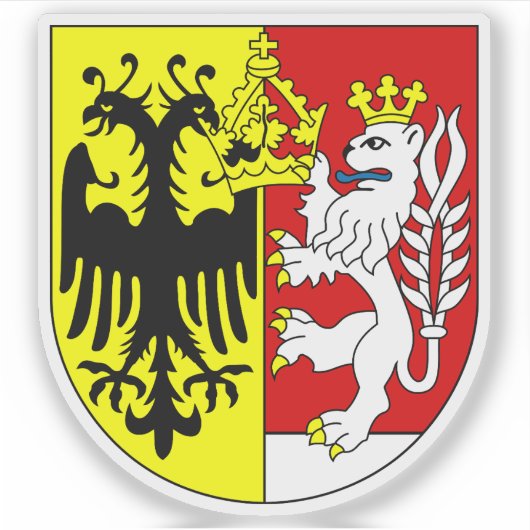
Wapen van Görlitz, Duitsland Sticker
Görlitz ([ˈɡœʁlɪts]; Lower Sorbian: Zgórjelc; Upper Sorbian: Zhorjelc [ˈzhɔʁʲɛlts]; Polish: Zgorzelec [zɡɔˈʐɛ.lɛt͡s]; Czech: Zhořelec [ˈzɦor̝ɛlɛt͡s]; East Lusatian: Gerlz, Gerltz, Gerltsch) is a town in the German state of Saxony. It is on the river Lusatian Neisse and is the largest town in Upper Lusatia, the second-largest town in the region of Lusatia after Cottbus, and the largest town in the German part of the region of Silesia. Görlitz is the easternmost town in Germany and lies opposite the Polish town of Zgorzelec, which was the eastern part of Görlitz until 1945. The town has approximately 56,000 inhabitants, which make Görlitz the sixth-largest town in Saxony. It is the seat of the district of Görlitz. Together with Zgorzelec it forms the Euro City of Görlitz/Zgorzelec, which has a combined population of around 86,000.
Görlitz, first mentioned in 1071, developed as a key trading town on the Via Regia route linking Western and Eastern Europe. In the Late Middle Ages, it prospered through the cloth trade and became a member of the Lusatian League, enjoying considerable autonomy. The town came under Bohemian, Hungarian, Austrian and Saxon rule before becoming part of Prussia in 1815 after the Congress of Vienna. During World War II, Görlitz was spared major destruction, but the new Oder–Neisse line in 1945 divided it from its eastern districts, which became Zgorzelec in Poland. In the GDR era, Görlitz was a border town with limited cross-border contact, but after German reunification and Poland’s EU accession, cooperation with Zgorzelec increased. Today, Görlitz is renowned for its well-preserved historic architecture and frequent use as a film location
Görlitz is culturally diverse. Immediately to the west of Görlitz lie Sorbian-speaking parts of Lusatia, and Görlitz was founded and first settled by the Sorbs, a Slavic people. This is evidenced by the name of the town and the etymology of some of its surrounding villages and geographical features being of Slavic origin. Görlitz itself speaks the East Lusatian dialect of German (Ostlausitzer Mundart), which is related to Silesian German dialects and differs from the Upper Saxon dialects spoken in most parts of Saxony. It is home to the Schlesisches Himmelreich and Liegnitzer Bombe, a Silesian Museum (Schlesisches Museum zu Görlitz), and the Silesian Christmas Market (Schlesischer Christkindelmarkt).
As of 2025, structural change, internationalisation, and transformation are central themes in the city’s development. At the same time, Görlitz is increasingly developing into a science centre of supra-regional and international importance. In addition to the Zittau/Görlitz University of Applied Sciences (known as Lusatia), which focuses on social change processes in both the technical and natural sciences as well as the social sciences, the Technical University of Dresden (University of Excellence), the University of Leipzig and HHL are also active in Görlitz with branch offices, study programmes or research institutes. The city is also home to several Frauenhofer Institutes, research groups and labs, the Senkenberg Institute of Natural History, the CASUS Center of Advanced Systems Understanding, which belongs to the Helmholtz Association, the Interdisciplinary Centre for Ecological and Revitalising Urban Transformation (IZS), which is part of the Leibniz Institute of Ecological Urban and Regional Development, and the German Centre for Astrophysics (DZA). The investment volume for the DZA alone amounts to 1.25 billion euros. Görlitz is also home to the Oberlausitzische Gesefllschaft der Wissenschaften (Upper Lusatian Society of Science), which was founded in 1779 and is one of the oldest German scientific societies. The influx from abroad, which has led to an international population share of almost 17%, is now having a positive effect on population development.
Ontwerp van international designer

Klant beoordelingen
5.0 van 5 sterren beoordeling2 aantal beoordelingen
2 Reviews
Beoordelingen voor identieke producten
5.0 van 5 sterren beoordeling
5 van 5 sterren beoordelingDoor Bien R.17 april 2023 • Geverifieerde aankoop
15,2 cm x 15,2 cm vel Op maat gesneden vinyl stickers, Glanzend transparant
Zazzler recensent programma
Snel en correct geleverd! Zoals gehoopt :) leuk en makkelijk te bevestigen
5.0 van 5 sterren beoordeling
5 van 5 sterren beoordelingDoor J.18 augustus 2021 • Geverifieerde aankoop
7,6 cm x 7,6 cm vel Op maat gesneden vinyl stickers, Mat wit
Zazzler recensent programma
Deze pictogram is handig om aan te tonen dat gij kunt parkeren op plaatsen met minder mobiliteit. Zeer klantgericht uitvoering.
Tags
Andere Info
Product ID: 256182777036773620
Ontworpen op: 5-10-2025 23:55
Rating: G