Cartes de visite juridique et finance
Cartes de visite marketing et com
Cartes de visite sport et fitness
Cartes de visite beauté et soins
Cartes de visite BTP et artisanat
Cartes de visite restauration
Cartes de visite photographie
Cartes de visite santé et bien-être
À propos de Mugs
Vendu (e) par
À propos de ce design
The velvet details are simulated in the artwork. No actual velvet will be used in the making of this product.
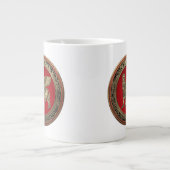
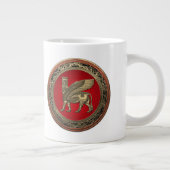
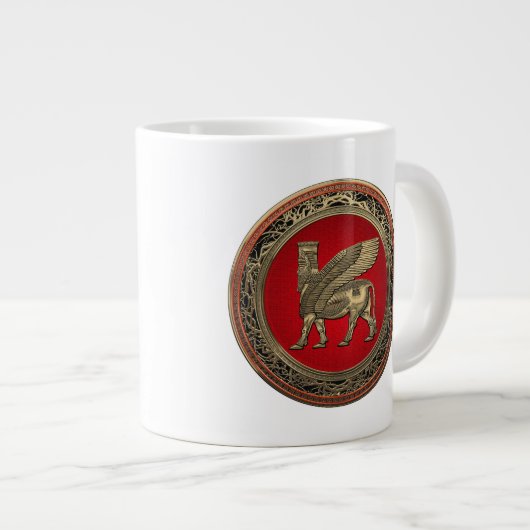
Grande Tasse Assyrian Winged Bull
Introduction ‘Treasures of Mesopotamia’ Collection by Serge Averbukh, showcasing new media paintings of various historical artifacts and symbos from the région. Here you veut des pieces featuring Assyrian Winged Bull - Silver Lamassu over Red Velvet. Mésopotamia a région historical de l'Asie de l'Ouest, où les Euphrates du Tigre sont enriver system, dans des régions modernes de roughly correspondance to most of Iraq plus Koweït, dans les régions eastères de la Syrie, Southeastern Turkey, et regions along the Turkish-Syrian et Iran-Iraq borders. Assyria, un major Mesopotamian kingdom and empire of the ancient Near East and the Levant. It existed as a state from perhaps as early as the 25th century BC in the forme of the assur-state, until collapse between 612 BC and 609 BC, tening the early to Middle Bronze Age through to the Late Iron Age. From the end of the seventh century BC to the mid-seventh century AD, it survived as a geopolitical entity, for the most part ruled by foreign powers, although a number of Neo-Assyrian states arose at different during the Parthian and early Sasanian betres ween the mid-second century BC and late third century AD, a period which saw Assyria become a major centre of Syriac Christianity and the birthplace of the Church of the East. Centered on the Tigris dans l'Upper Mésopotamia (Iraq moderne, Syrie du nord-est, Turkey et les fringes du nord-est de l'Iran), les Assyrians cament to rule powerful empires at several times . Making up a substantial part of the greater Mesopotamian "cradle of civilization", which included Sumer, the Akkadian Empire, and Babylonia, Assyria was at the height of techncal, scientific and cultural achievements for time. At its peak, the Assyrian Empire stretched from Cyprus et the East Mediterranean to Iran, and from what is now Armenia and Azerbaijan in the Caucasus, to the Arabian Peninsula, Egypt and eastern Libya. A lamassu, plural lumasi (Sumerian: dlammar; Akkadian: lamassu; sometimes called a lamassus) is à Assyrian protective deity, ofen depicted as having a human's head, a body of a bull or a , and bird's wings. Dans les some writings, it is portrayed to represent ent a female deity. A less frequently used name is shedu (Sumerian: dalad; akkadian: shedu) which refers to the male counterpart of a lamassu. Le Lammasu ou Lumasi represent the zodiacs, parent-stars or constellations. The Lumasi represent the zodiacs, parent-stars, ou constellations. They are depicted as protective deities because they encompass all life within them. La protection des maisons, le lumasi va graved in clay tablets, which were then buried under the door's threshold. They va faire un placed as a pair at the entrance of palaces. At the entrance of cities, they were Sculted in colossal size, and placed a pair, one at each side of the door of the city, that generally had doors in the surrounding wall, each one looking towards one of the cardinal points. In the Sumerian Epic of Gilgamesh they are depicted as physical deities as well, which is where the Lammasu iconographiy originates, these deities could be microcosms of their cosmic zodiac, parent-star ou constellation. Although "lamassu" had a different iconographiy and portrayal in Sumerian culture, the terms "lamassu", "alad", and ' shedu" evolved throughout the Assyro-Akkadian culture from the sumerian culture to denote the Assyrian-winged-man-bull et statues during the Neo-Assyrian. Female lumasi Called "apsasu"
Traduction automatique

Avis des clients
Aucun commentaires sur ce produit pour le momentAvez-vous acheté ce produit ?
Tags
Autres infos
Identifiant du produit : 183323016880788999
Fabriqué le 17/04/2018 4:39
Évalué G